
Women’s health represents a major growth opportunity for health systems, with a $360 billion market across high-value service lines like cardiology and neurology. As key decision-makers for 80% of household healthcare spending, women are active researchers who value self-advocacy and digital transparency. By expanding the definition of women’s health beyond reproductive care and addressing historic medical bias with clear, trustworthy content, health systems can build trust and strengthen long-term patient loyalty.
Health systems that define women’s healthcare too narrowly are missing one of their biggest growth opportunities. Ask most people what falls under the women’s health umbrella, and the answer is still often limited to reproductive care, including OB-GYN visits, fertility treatments, and prenatal care. These services matter enormously. But in reality, women’s healthcare spans a much broader range of conditions—such as cardiology, neurology, and autoimmune care—and when organizations treat it otherwise, it limits how they approach growth, service lines, and patient acquisition.
Women are one of the most critical audiences any healthcare organization can reach. They drive 80% of healthcare spending and decision-making, not only for themselves but also for the children, partners, and aging family members who depend on them to navigate the system.
Health systems that recognize the broader scope and impact of women’s health can engage patients earlier in their health journey. The question is whether they’re positioned to do so effectively.
The “Hidden” Opportunity in Women’s Health
Women’s health is not just limited to OB-GYN, fertility, and pregnancy, yet most healthcare strategies don’t reflect that reality. Many of the conditions that most significantly affect women are not framed as part of a women’s health strategy. Instead, they live in separate service line buckets, marketed to a general audience and disconnected from how women experience illness, seek care, and make healthcare decisions.
That oversight comes at a cost. Some of the biggest areas of unmet need are conditions that affect women differently or disproportionately. EMARKETER estimates a $360 billion gap tied to these conditions—a figure that represents both the scale of underservice and the need for health systems willing to think more expansively about how they support women’s health.
The conditions driving that pattern span several of the highest-value service lines in healthcare:
- Cardiovascular disease, the leading cause of death for women, is rarely marketed through a women’s health lens
- Autoimmune disorders, where 78% of autoimmune disease patients are women, making this one of the most female-skewing diagnoses in medicine
- Neurological conditions, which present differently in women and are frequently understudied in female populations
- Osteoporosis, a condition that disproportionately affects women—particularly postmenopause—with significant long-term care implications
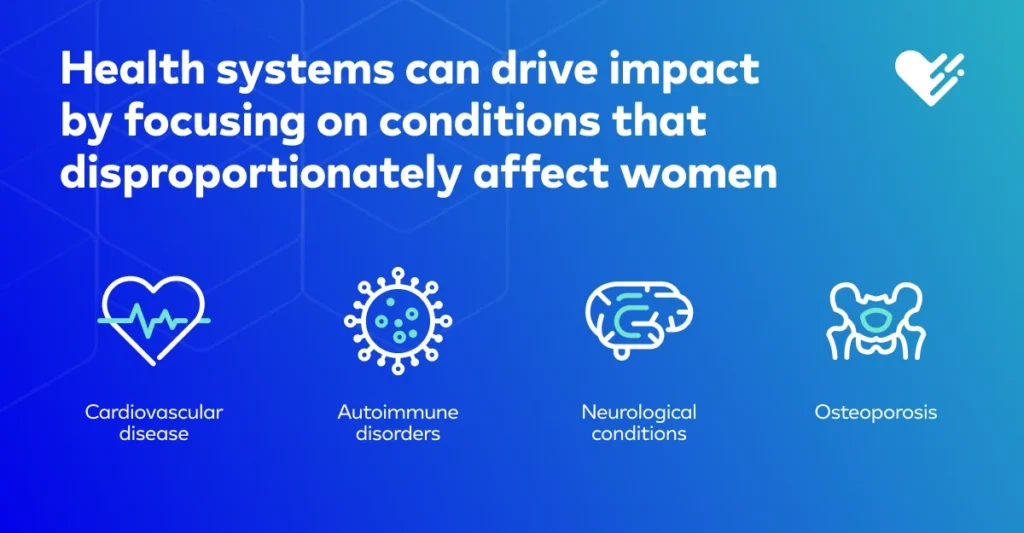
What these conditions share is that many of them are underdiagnosed, poorly understood in a female context, and are rarely promoted as part of women’s health offerings. The clinical need is clear, but the marketing connection is often missing.
The impact extends far beyond a handful of overlooked conditions. Excluding maternity-related care, women use 9.9% more health care services than men, reinforcing that their medical needs encompass more than reproductive care. That demand also carries financial weight: spending on key conditions affecting women is projected to exceed $100 billion by 2030.
Women’s health is not a niche; it spans multiple high-value service lines that are often under-promoted, under-resourced, and disconnected from the audiences they serve. For health systems, that gap isn’t simply a clinical problem; it’s one of the clearest growth areas in service line marketing today.
Women Are Driving Their Own Healthcare Decisions
Women are more than patients. They often shape healthcare decisions for their entire households, and much of that process begins before any clinical interaction. More than 90% search online for medical information, and 45.2% are researching care for a family member or dependent.
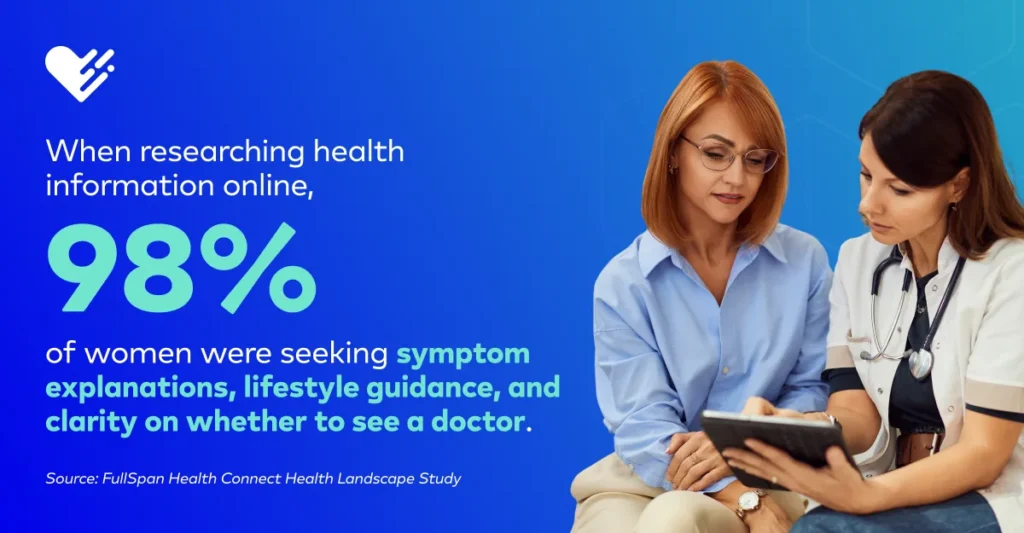
Digital channels play a major role in that research. A recent study conducted by Fullspan Health found that in the past three months alone, 81% of women researched a health topic online.1 Of those, 49% visited a health information site, and 26% used a doctor finder site—meaning 62% of women used an online resource to find health information or locate a physician.1 In that same study, 80% turned to search engines when looking up health topics. Most notably, 98% of women were looking to take action, identify explanations for symptoms, get lifestyle guidance, and decide whether they needed to see a doctor.1
The Trust Gap: Medical Bias and the Rise of Self-Advocacy
Many women enter the research process already carrying frustration shaped by medical bias—and often for well-documented reasons. That history is also driving a rise in self-advocacy that healthcare organizations need to understand.
According to EMARKETER, 34% report having had a negative healthcare experience. Of those, 20% say a question was ignored during a clinical interaction, and 17% say they were not believed by their doctor.
These findings reflect a pattern rooted in decades of systemic gaps in how women’s health has been studied, understood, and treated. Many diagnostic standards remain based on male-centric studies, as documented by the AAMC, contributing to misdiagnosis, delays in care, and symptoms that are routinely dismissed.
For many women, that experience doesn’t stay in the exam room. Repeatedly feeling unheard in medical settings can erode confidence in the system itself, affecting how and whether women seek care over time.
The information environment compounds the problem, with 68% of women having encountered confusing or inaccurate health information online. Even when patients turn to digital resources for answers, they’re often sorting through noise to find something credible.
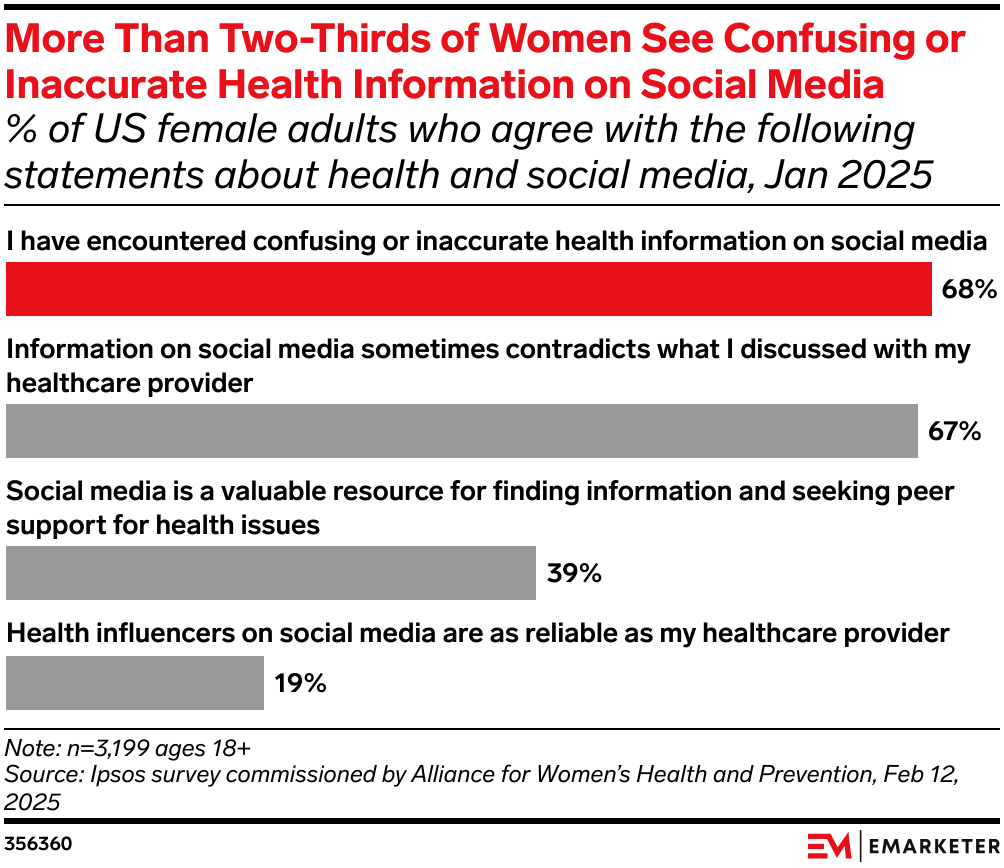
The result is a population that is highly engaged but cautious. Many have learned, out of necessity, to research extensively, advocate for themselves, and carefully evaluate their options before committing to care. Organizations that meet this audience with clear, credible, and compassionate information are more likely to earn their trust.
What This Means for Health Systems
Women are evaluating more doctors, comparing treatment options across specialties, and arriving at that first digital touchpoint with higher expectations than ever. The shift has real implications for how organizations approach marketing, content, digital experience, and long-term patient engagement.
Responding effectively starts with rethinking how women’s health is framed and integrated across care.
Broaden How Women’s Health Is Defined and Marketed
Start by expanding the definition. Moving beyond reproductive care means actively including the conditions that affect women at higher rates or in distinct ways—and reframing key service lines like cardiology, neurology, and autoimmune care through a women’s health lens where the data support it. These specialties are not traditionally framed as part of a women’s health strategy, but the evidence makes it clear that they should be.
In addition, take a whole-person health approach that connects different stages of care, rather than treating each specialty in isolation. Women don’t experience their health in silos. Their care strategies shouldn’t either. That same connected mindset should shape how health systems communicate with women long before an appointment is scheduled.
Align Messaging With How Women Actually Research Care
Women researching health information are not looking for general education. They are trying to take specific actions: understand symptoms, explore treatment options, know when screenings are needed, and set expectations for what comes next. Content that supports those early stage needs establishes a health system as a trusted resource before an appointment is ever scheduled.
That need for guidance does not stop after a diagnosis. According to a recent Health Events Survey conducted by Healthgrades’ parent company, nearly 80% of patients become more focused on their health after a major health event, but 66% say it’s difficult to sustain that focus over time. Organizations that provide support at key health inflection points—not just at the point of acquisition—are far better positioned to maintain engagement.
This requires investing in resources that meet people where they are, including:
- Educational content that answers common patient questions
- Intuitive doctor research tools
- Clear care pathways
- Easy ways to schedule follow-up care or connect with the right specialists
With 51% of patients saying the ability to ask health experts questions would be helpful during a health challenge, it’s clear many are not finding the support they need. That includes questions they may hesitate to raise in clinical settings and acknowledgment of the role self-advocacy plays in the care journey. Women who have felt dismissed or unheard are less likely to trust a system that does not reflect that understanding. Messaging that validates their experience and supports informed decision making builds a stronger relationship than outreach focused on acquisition alone.
Show Up Earlier in the Digital Journey
Women are searching online for conditions, treatments, and doctors before making any decisions. Health systems that aren’t present at that stage risk being overlooked by a significant portion of their potential patient base.
Strong physician and service line visibility across search engines and healthcare platforms helps ensure the right information appears when patients are actively looking for care. Once they find what they need, the path forward should be frictionless. More than two-thirds of patients prefer to book appointments online, and 55% would consider switching to a doctor who offers that option.2 Making it easy to move from information to scheduling in as few steps as possible is one of the highest-leverage investments your organization can make.
Build Trust Through Credibility and Transparency
Given the skepticism many women bring to healthcare interactions, your organization cannot afford to distribute vague or generic content. Health systems need to demonstrate expertise, highlight positive clinical outcomes, and ensure that physician profiles and digital touchpoints are accurate, complete, and easy to understand. Incomplete or outdated profiles don’t just create technical issues; they erode trust at the moment a patient is deciding whether to take the next step.
Consistency reinforces that foundation. Reliable, well-sourced content across channels signals that an organization takes women’s health seriously—across all conditions affecting women, not just those traditionally marketed to them.
Think Beyond Acquisition to Long-Term Engagement
Women’s health is not a one-time interaction. Care often unfolds across multiple conditions, over many years, and for multiple people within a household. Strategies that treat every patient interaction as a stand-alone acquisition miss something far more valuable.
Experiences that support ongoing engagement through follow-up content, continuity across care touchpoints, and digital tools that make it easy to stay connected can strengthen loyalty and retention in ways one-time outreach cannot. Organizations that invest in that continuity are more likely to become a lasting part of how women manage their health, rather than a place they visited once.
How Healthgrades Helps Health Systems Reach Women—and Win Their Trust
Women are researching sooner, comparing more options, and evaluating a broader range of women’s health specialists than ever before. For health systems, that means more opportunities to influence the decision making process, but also more competition for attention. Reaching this audience takes more than a strong clinical reputation. It also requires a digital presence that is visible, credible, and easy to act on.
Healthgrades is a digital healthcare concierge that uses over two decades of clinical expertise, proprietary data, and clinician-backed algorithms to match patients with the most relevant doctors for their needs. This intelligence drives higher-value patient acquisition and more meaningful connections between patients and care teams.
Connect with the industry’s most engaged audience of high-intent consumers. With 4.5 million active, appointable healthcare professionals*—more than any other health site—we ensure your HCPs are visible when care decisions are made.
For Health Systems
Healthgrades’ suite of solutions is designed to increase visibility and build credibility earlier in the healthcare journey. Our solutions reduce friction between research and care, turning intent into appointments:
- Advertising Solutions (Sponsored Profiles): Ensure your physicians and service lines are prominently visible when patients are actively searching for care. With premium placement, branded physician profiles, and clear calls to action, your health system appears first in healthgrades.com search results and doctor profile pages. Your physicians are also featured as alternatives on competitor profiles, helping redirect appointment opportunities at key decision moments. In addition, your campaigns are syndicated across the Healthgrades network, including Healthline, Sharecare, and Medical News Today.
- Brand Solutions: Reach high-intent healthcare consumers across digital channels using Healthgrades Audience Intelligence, ensuring your health system is visible to women actively researching conditions, treatments, and specialists. Maximize your brand’s reach to your target audience on Healthgrades and extend it to wherever they are across CTV, web, video, or audio.
- Online Appointment Scheduling (OAS): Reduce friction and allow patients to book directly once they’ve made a decision. Fully integrated with your health system’s existing EMR, this solution supports real-time appointment scheduling, cancellations, and rescheduling directly from your doctors’ profiles.
- Quality Awards: With Healthgrades Quality Awards, you can showcase your hospital’s clinical excellence and bring your national and specialty recognitions to the forefront of your brand. From award-winning care to data-backed outcomes, make it easy for patients to see why they should choose you right from their very first search.
For Physicians and Other Healthcare Professionals
Your online presence is often the very first impression a healthcare seeker has of you—before a referral, before a phone call, before any clinical interaction. Claiming and optimizing your free Healthgrades profile is a straightforward and effective way to showcase your expertise and build credibility with patients who are already searching for someone like you.
Elevated Profiles take that presence further, highlighting your areas of expertise, removing competitor and consumer ads, and adding a direct scheduling link so patients can move from finding you to booking with you in a single step.
As health systems look to serve women across the full spectrum of their care needs, showing up early and earning trust at every touchpoint is what separates organizations that patients return to from those they visit once.
Get in touch with us today to learn how Healthgrades can help you connect with women earlier and build more meaningful, lasting patient relationships.
*Inclusive of: Physicians, Dentists, Mid-Level Practitioners, Counselors, and other Healthcare Professionals.
1 Fullspan Health Connect Health Landscape Study. Feb 2026. N=1,000 US adults. Data weighted to be representative of gen pop based on gender and age.
2RVO Health, Health Events Survey, Oct 25-30, 2025; N=2,096 U.S. consumers (Suzy On-Demand)
3Healthgrades (in partnership with RVO Health), Reviews and Online Booking Survey, April 14–May 15, 2025; N=1,089 U.S. consumers