
Jul 03, 2025
|Blog
John Davey on Harnessing AI, Smarter Feedback Loops, and Driving Patient Loyalty at Mount Sinai
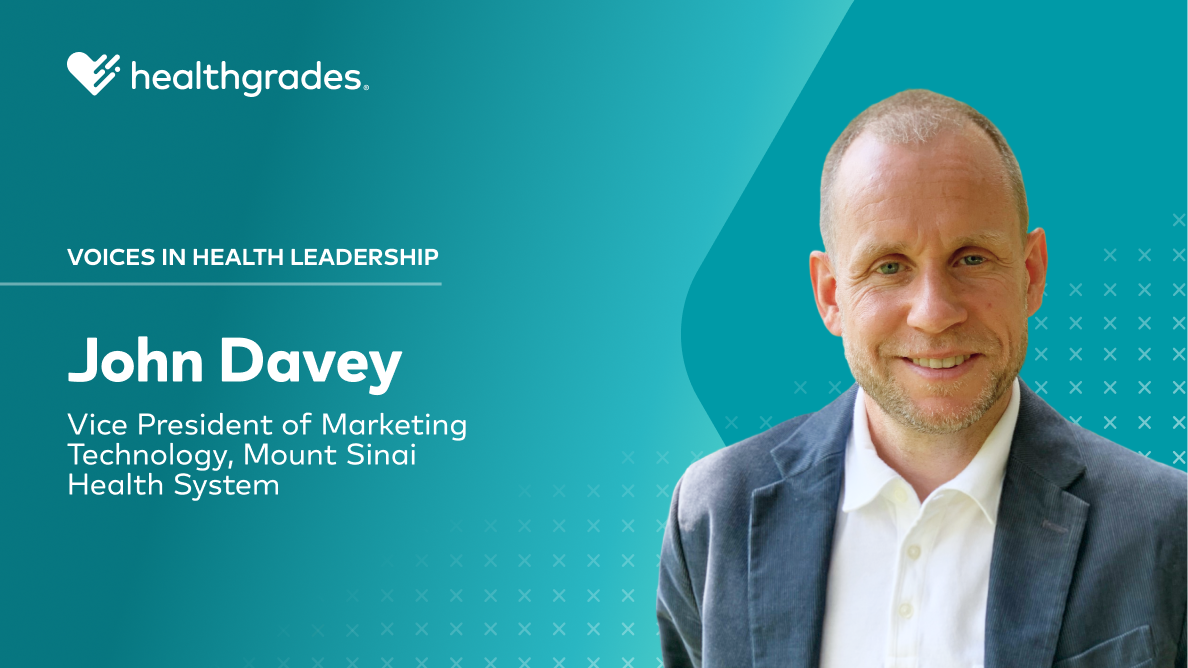
Voices in Health Leadership is a series spotlighting healthcare leaders reimagining access, experience, and innovation in a rapidly evolving landscape. Through candid conversations, we explore the real-world stories, strategies, and leadership insights shaping the future of care delivery.
John Davey, VP of Marketing Technology at Mount Sinai Health System, joins Healthgrades’ Audrey Keller to explore how AI, digital transformation, and smarter feedback loops are helping health systems evolve to meet rising consumer expectations—and deliver more connected, patient-centered care.
To help set the stage, can you introduce yourself and share what first drew you to the healthcare space—and what continues to fuel your passion for the work?
I’m John Davey, and I’m the Vice President of Marketing Technology at Mount Sinai Health System. I got my first job in healthcare working on the Memorial Sloan Kettering Cancer Center website. It turned out to be incredibly rewarding. You can do marketing and communications work in any industry, but in healthcare, you’re indirectly connected to helping people—people who are often going through something really difficult. That sense of purpose has kept me in this space ever since.
As the healthcare landscape evolves, what shifts are you seeing at Mount Sinai that are reshaping patient expectations and influencing how care is delivered?
Like so many industries, COVID had a massive impact—but in healthcare, we were right in the middle of it. From a marketing perspective, we think of our patients as customers, and during that time, their expectations changed drastically. That accelerated change hasn’t slowed down—it has only continued since.
It’s all about convenience now and meeting people’s needs in real time. Healthcare, as you know, has traditionally lagged in those areas, which has made things harder for patients. In the past, consumers were more flexible with these limitations, simply because there weren’t many alternatives. But during COVID, especially at the height of the pandemic, patients became more empowered. The rapid rise of virtual care options really fed into that need for convenience, and we, in healthcare, realized we had to change as the world changed.
You’ve touched on how the pandemic accelerated digital expectations. From your perspective, how should organizations define and measure meaningful engagement in this new era of digital transformation?
As people started doing more online, it only made sense that virtual care became part of that expectation. And like most digital experiences, the outcomes, returns, and success rates can be measured in a way that hasn’t always been possible with traditional models of care.
Patient expectations around access and convenience have changed, and the way we measure success in meeting those expectations has evolved, too. Today, it’s much easier to get real-time feedback.
As part of that shift toward real-time, measurable engagement, how is your team using patient reviews to shape the consumer experience? What kind of impact have you seen from investing in that feedback loop?
Patients are customers, and one of the most powerful things they can do today is rate their experience online. We’ve seen research showing that prospective patients place a lot of value on what others are saying—and that feedback directly influences where they choose to go for care. That’s why we’re focused on delivering the best possible product and encouraging those who’ve had a positive experience to share it. We’ve found that when we ask for more reviews, we get more positive ones, because we know we’re offering world-class care across nearly every specialty.
So, when we follow up with patients after a visit and ask them to leave a review, the response is often positive. But beyond the marketing side, there’s another big benefit: it gives us a chance to do real service recovery.
If someone shares negative feedback—maybe about long wait times, a poor front desk interaction, or even a concern with the clinician—it gives us a direct window into the issue. More importantly, it gives us the opportunity to address it. That kind of feedback loop didn’t always exist in healthcare. For a long time, medicine was more of a one-way conversation. But today, it’s an open conversation.
If someone shares negative feedback—maybe about long wait times, a poor front desk interaction, or even a concern with the clinician—it gives us a direct window into the issue. More importantly, it gives us the opportunity to address it. That kind of feedback loop didn’t always exist in healthcare. For a long time, medicine was more of a one-way conversation. But today, it's an open conversation.
John Davey, VP of Marketing Technology, Mount Sinai Health System
When patient feedback highlights parts of the experience outside a clinician’s direct control, how do you help teams approach that holistically?
Our doctors generally receive amazing ratings for the care they provide. However, in a large health system—especially one like ours in New York City, with a high volume of patients—you will encounter issues. A patient may have received excellent care, but if the waiting room experience was poor or they had a rude interaction at check-in, they might still walk away saying, “I don’t want to go back there.”
What’s important is that our practice managers and operations teams know that, and we treat the feedback as constructive. The good news is that feedback like this is now more accessible than ever, not only to other patients but also to our internal teams. In the past, a department might not have known something was an issue, but now knowing that information lets us address it more directly.
In a market as competitive as New York City, that’s especially important. If a patient has a bad experience, they have plenty of other options just blocks away. So surfacing this kind of feedback is a big opportunity—as long as you take it seriously and use it to improve the experience.
Let’s talk about virtual care. In such a competitive market, how is Mount Sinai differentiating its telehealth and asynchronous offerings from virtual-first platforms?
It’s a crowded market to begin with—especially here in New York City. On top of that, we’re seeing new players enter the space, often backed by significant venture capital. While they may not offer better clinical care, they’re investing heavily in creating smoother, more convenient experiences.
They’re prioritizing user-friendly interfaces and ease of access. As patients bring new expectations—not just about when and where they receive care, but how they access it—that kind of experience starts to matter just as much as the care itself. Of course, that creates a challenge for us. We’re competing against companies that might not have the clinical excellence we do, but they’re setting new standards around digital tools and interactions.
So we have to keep up—and we often have to do it without the same VC-backed resources. But it’s what keeps us constantly iterating and evolving. In the end, that’s a good thing. It benefits patients. These new players are also modernizing how healthcare is marketed—making it simpler, more direct, more compelling—and that’s another area where big health systems have had to step up.
As patients bring new expectations—not just about when and where they receive care, but how they access it—that kind of experience starts to matter just as much as the care itself.
John Davey, VP of Marketing Technology, Mount Sinai Health System
On the virtual care side, I’ll also say this: we already have the clinical intellectual property, the experts, the specialists. Virtual care—when done right—lets us scale that expertise. We can see more patients more efficiently and still deliver excellent care. It’s better for patients because they can access care in the way that’s most convenient to them. It’s also better for the system because it helps maximize our doctors’ time and reach. When done right, it’s about bringing those two sets of needs together and finding where the event sits in that Venn diagram.
Given how varied patient needs can be, how are you striking a balance between those who expect a high-touch digital experience and those who are more comfortable with traditional care? How do you approach educating them about virtual options?
There are definitely different groups of patients, but many of our initial assumptions about who would want virtual care turned out to be wrong. We thought it might be age-based—that younger people would prefer virtual care—but that didn’t really hold up. The reality is that the massive shift brought on by COVID changed everyone’s expectations, regardless of age. So, we try not to make assumptions based solely on demographics.
Many of our initial assumptions about who would want virtual care turned out to be wrong. We thought it might be age-based—that younger people would prefer virtual care—but that didn’t really hold up. The reality is that the massive shift brought on by COVID changed everyone’s expectations, regardless of age.
John Davey, VP of Marketing Technology, Mount Sinai Health System
It really comes down to offering flexible options for everyone. One thing that’s helped a lot is the widespread adoption of patient portals. More and more people are becoming comfortable using them, and even in a crowded market, many are interacting with a version of the same portal experience, so there’s familiarity and trust built in.
What’s great is that we can plug different virtual care options right into that portal. So, when a patient logs in after an in-person visit to check test results or refill a prescription, they might also see that they can schedule a virtual urgent care visit just as easily. It’s about making it convenient and seamless.
For us, it’s all about clearly communicating those options. Whether the call to action drives people to our website or mobile app, the goal is to make it feel like one-stop shopping.
You mentioned earlier that age didn’t end up being as big a factor as expected. Are there any other interesting demographic trends or fluctuations you’ve noticed?
One thing we found is that there’s a subset of older adults who are just as comfortable and engaged with virtual tools as younger groups. That’s not to say it applies across the board, but we were definitely wrong in assuming that older patients wouldn’t adopt these technologies.
Another interesting demographic trend we’ve noticed is that most of our portal users are women. Now, we have a huge user base—millions of people use the portal—and plenty of men are on it, too, but there’s a clear majority of female users.
We’ve started paying closer attention to what we call the “Sandwich Generation” woman, those who are typically between the ages of 45 and 64. These women aren’t just managing their own health. They’re often also making care decisions for their spouses, their children, and their aging parents, more so than their male counterparts. It’s a really important dynamic and a big opportunity when you think about how to communicate and build tools that support that kind of caregiving role.
I’d also love to hear your thoughts on AI. Are there any promising use cases you’ve seen in marketing that feel especially exciting or impactful?
From a marketing standpoint, it’s incredible how quickly everything is changing—both the world at large and the technology itself. Even just thinking back to this time last year, we were only beginning to talk about AI. We were dabbling, experimenting. Now, we’re fully using these tools in nearly every aspect of marketing and communications at Mount Sinai. Of course, we’re using them carefully, with the proper guardrails in place. But they’ve truly been a game-changer. The fears around AI, particularly that it might replace jobs, aren’t unfounded, but in our experience, it’s more about how we marshal these tools to become more efficient and effective as marketers. It’s not about replacement; it’s about enhancement. The people learning to use AI well—crafting better prompts and applying them thoughtfully—are becoming even more valuable to the team.
We’re seeing it across the board: in creative services, teams use AI tools to generate infographics, videos, and imagery. On the coding side, in social media, website content, and metadata, even for things like PowerPoint creation, it’s transformed how we work. It’s made everything faster and more efficient.
It’s scary to think about where we’d be if we hadn’t leaned into it. And the pace of change is only accelerating—it’s a hockey stick curve now. We know we can’t afford to be left behind.
One of the biggest challenges I often hear is how difficult it can be to get approval to use AI tools, especially with valid concerns around privacy and safety. How is Mount Sinai navigating that balance between speed and compliance when adopting AI tools across marketing and communications?
Healthcare—like finance—is one of the most heavily regulated industries, and for good reason. So when it comes to AI, the guardrails are hard and fast.
We don’t connect AI tools to systems containing patient data. Another basic guardrail is that a human always reviews the final product before it is published. We’ve all seen those AI hallucinations or occasional inaccuracies, and in healthcare, even a small mistake can be really problematic.
In our case, the Marketing and Communications team is helping to shape our organization’s official guidelines for AI use. We’re working closely with IT, legal, compliance, and security to make sure everything we do is safe and aligned with those standards.
So yes, we need to be incredibly careful. At the same time, some of these rules are simple: don’t connect to patient data, and always have human eyes on anything before it gets released. Once you start using the tools and see how unpredictable they can be, it becomes clear why those checks are so important.
About Mount Sinai Health System
Mount Sinai Health System is one of New York City’s largest academic medical systems, with seven hospitals, over 400 ambulatory practice locations, and two schools—the Icahn School of Medicine and the Phillips School of Nursing. Formed through the merger of Mount Sinai Medical Center and Continuum Health Partners, the system serves communities across the five boroughs of New York City, Westchester, and Long Island. With a team of over 48,000—including over 9,000 physicians—Mount Sinai delivers a full continuum of care, from primary services to complex specialty treatments, while advancing research, education, and equity-focused health outcomes across its diverse patient population.
Looking to improve digital access and patient engagement at your health system? Get in touch with us today to learn how Healthgrades can help you connect with the right patients at the right time—the moment they’re ready to book an appointment.