
U.S. health systems have faced a wide range of challenges since the onset of Covid-19, from chronic workforce shortages and rising costs to increased patient acuity and widening coverage gaps. Sweeping policy changes have effectively reshaped the nation’s healthcare landscape over the last ten months, resulting in further economic uncertainty for providers.
Amid these challenges are new opportunities for growth and improvement. The 2026 Specialty Excellence Report explores the top issues hospitals face as they strive for economic stability and offers insight on how organizations can improve both their clinical outcomes and their bottom line.
Healthgrades published this report with the release of its 2026 Specialty Excellence Awards and Ratings and 2026 Specialty State Rankings. These achievements recognize hospitals that deliver consistently better-than-expected outcomes across 31 common procedures and conditions. For its 2026 analysis, Healthgrades evaluated risk-adjusted complication and mortality rates at approximately 4,500 U.S. hospitals to identify the state and national leaders in specialty care. Healthgrades’ 2025 recognitions for excellence in inpatient specialty care include state rankings, five-star ratings, and three national awards:
- Healthgrades Specialty Excellence Award™ – the top 10% of hospitals nationwide in 16 specialties
- Healthgrades America’s 100 Best Hospitals Award™ – the top 100 hospitals nationwide in 11 specialties
- Healthgrades America’s 50 Best Hospitals Award™ – the highest achievement Healthgrades offers for inpatient specialty care recognizes the top 50 hospitals nationwide in three specialties
- Healthgrades Specialty State Rankings™ – the top three or top five hospitals in 30+ eligible states across 18 specialties1
Alongside these inpatient achievements, Healthgrades announced the recipients of its 2026 Outpatient Awards, which recognize the top 10% of hospitals nationwide in three rapidly growing service areas:
- Healthgrades Outpatient Joint Replacement Excellence Award™
- Healthgrades Outpatient Orthopedic Surgery Excellence Award™
- Healthgrades Outpatient Prostate Care Excellence Award™
Through objective, service-line-specific awards and ratings, Healthgrades empowers patients to consider hospital quality during their search for specialty care. Excellence in one specialty does not always translate to other service areas: a hospital with a five-star rating for stroke care might be one-star-rated for sepsis. To maximize their likelihood of a successful outcome, consumers must look beyond convenience and select a hospital with top ratings in their specific procedure or condition to maximize their likelihood of a successful outcome.
Consumers can find resources on how to find a specialist and more through Healthgrades’ Patient Advocacy Center. Health systems interested in learning more about their 2026 specialty care achievements can get in touch with a Healthgrades team member.
2026 Hospital Ratings & Consumer Survey Insights
Access to outcomes-based hospital performance indicators has never been more valuable to U.S. healthcare shoppers. This pandemic-driven interest in quality continues to shape healthcare decisions, with third-party quality awards becoming increasingly influential in consumer care search. A Healthgrades consumer survey revealed the extent of this phenomenon:
- 80% of Americans report feeling more confident in their decision to seek care at a hospital with a quality award in their procedure or condition.2
- Over 75% say they would only choose a hospital with high quality ratings in their condition or procedure, and one-third identify quality awards as one of their top three criteria for selecting a hospital.2
- When choosing between two hospitals for an upcoming procedure, nearly two-thirds say they are more likely to pick a hospital with a third-party quality award over one without one.2
Patients seeking care at a hospital with specialty care distinctions from Healthgrades should feel confident that they are maximizing their chance of a positive outcome. According to Healthgrades’ specialty care analysis:
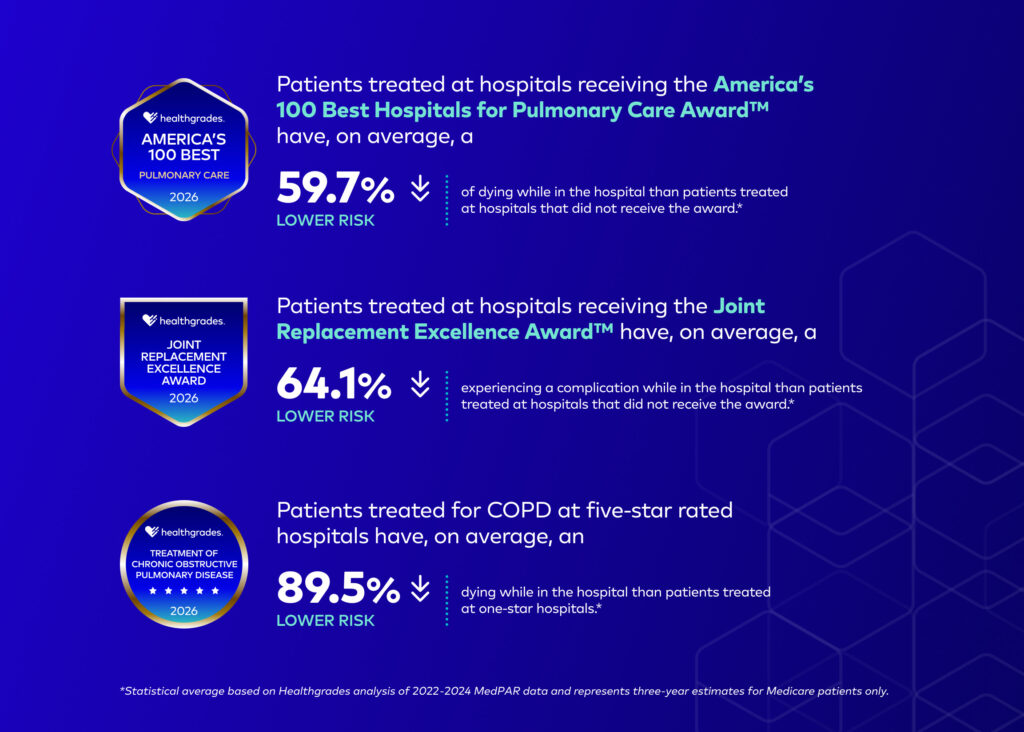
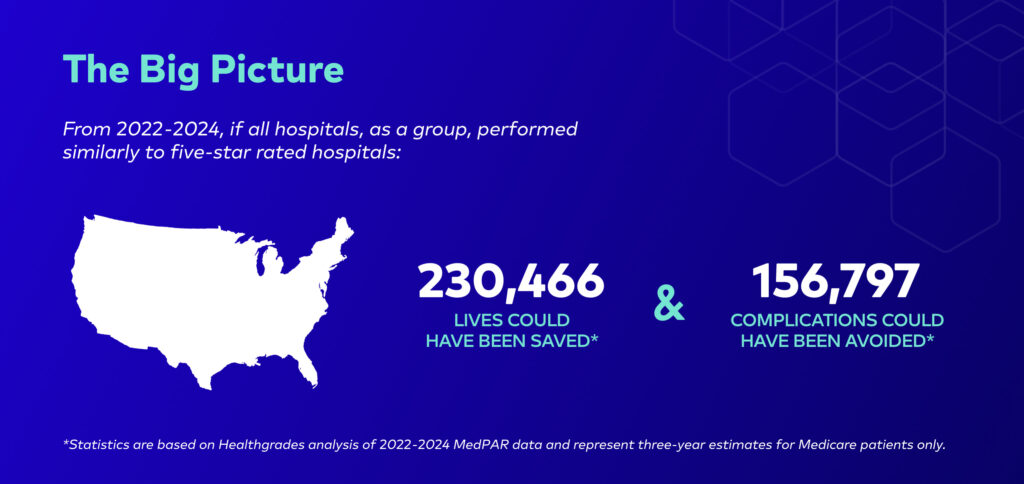
In addition to showcasing incredible achievements in specialty care, Healthgrades’ analysis revealed persistent disparities in hospital performance nationwide. These findings further underscore the importance of providing consumers with data-driven resources to identify care solutions that meet their unique health needs. Likewise, Healthgrades’ award and rating analysis offers hospitals valuable insights into their clinical strengths and weaknesses and opportunities to improve their care. Informed healthcare decision making and targeted clinical improvement are both vital to elevating patient outcomes, particularly as the achievement gap between the nation’s five- and one-star hospitals continues to grow.
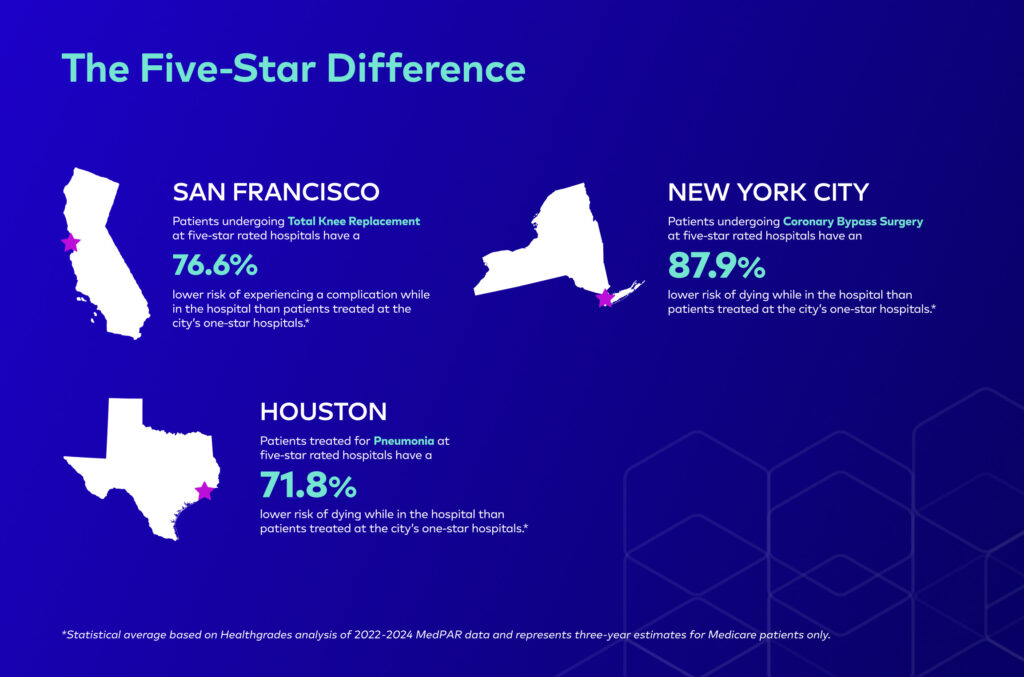
Healthgrades’ analysis also identified similar disparities in clinical quality at the local level, including substantial performance variation among hospitals within the same city.
The Financial Outlook
Year-end financial reports indicated significant improvement and overall stability for U.S. hospitals headed into 2025. The sector’s median operating margin experienced a 9% YoY increase compared to 2023, with similar gains in daily net operating revenue and net patient service revenue. Another cause for optimism is a recent decline in average length of stay (ALOS) resulting from reductions in severe patient acuity and improved patient flows.
While these broad improvements are encouraging, experts warn that focusing on industry averages overlooks the significant financial challenges many hospitals currently face. For example, a recent Advisory Board analysis found that when the median hospital operating margin reached 4.1% in May 2024, 40% of the nation’s hospitals were operating in the red. This dichotomy suggests that a handful of well-resourced organizations are fueling across-the-board gains while the rest of the industry struggles to catch up. Kaufman Hall’s latest “National Hospital Flash Report” illustrates how profitability continues to vary in 2025. Hospitals with 300-plus beds are capitalizing on their size and driving industry-wide growth as smaller facilities fail to break even in the face of mounting systemic pressures.
Losses associated with uncompensated care and rising supply costs represent a formidable challenge for organizations of all sizes. Despite early signs of waning expense growth, hospital expenses remain elevated after experiencing a 5.1% single-year increase in 2024, according to the American Hospital Association’s (AHA) latest “Cost of Caring” report. Despite skyrocketing drug and supply costs, labor-related expenditures still constitute the largest spending category for hospitals, accounting for 56% of total hospital spending in 2024. Compensation increases for hard-to-fill clinical roles continue to significantly outpace inflation as hospitals strive to recruit and retain critical staff.
Bad debt and charity care have also been on the rise in recent years, and uncompensated care is only expected to increase when federal policy changes go into effect next year. With an estimated $1.1 trillion in federal healthcare spending cuts expected over the next decade, hospitals must pursue dynamic cost containment strategies to weather ongoing financial headwinds and adapt to the new healthcare landscape. Harnessing the power of emergent technologies and capitalizing on site-of-care shifts are central to these efforts.
Shifting Care Preferences
Outpatient migration has been years in the making, but pandemic-induced pressures have fueled an unprecedented rise in surgical volumes beyond the hospital walls. Patient volumes are expected to return to pre-pandemic levels by the end of the year, but shifts toward non-acute care settings could undercut potential earnings for organizations that fail to diversify.
Demand for outpatient care is far from a passing trend. Sg2 projections point to an 18% increase in overall outpatient volumes over the next 10 years, along with modest growth in inpatient volumes due to rising acuity levels. Significant shifts are already underway in specific service areas, including orthopedics. Healthgrades’ 2026 analysis revealed that outpatient volume growth currently outpaces inpatient volumes for two critical procedures:
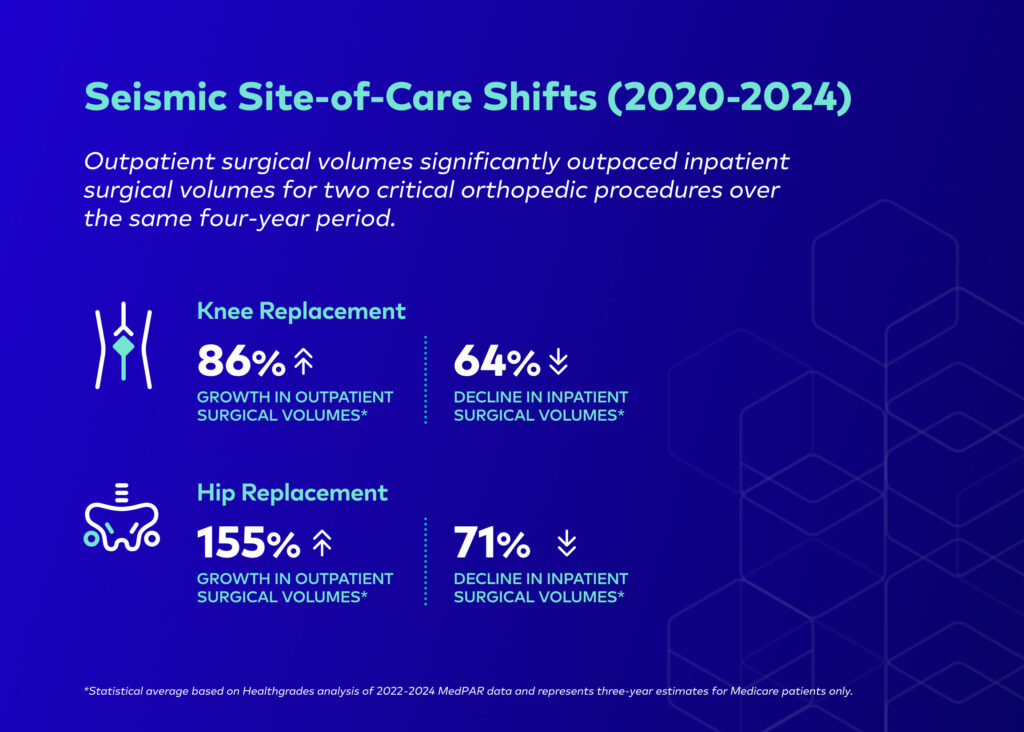
While outpatient migration does threaten inpatient revenue, site-of-care shifts also represent a $50 billion opportunity for industry stakeholders. Larger health systems have a considerable advantage in mitigating the financial impact of outpatient migration. However, there is still an opportunity for those unable to shoulder the burden of facility expansion alone. Shared referrals and volume trading through partnerships and affiliations are just two ways smaller healthcare providers can recapture inpatient revenue losses without compromising existing services.
AI-Powered Operational Efficiency
AI utilization represents another revenue opportunity for hospitals, and a growing number of organizations are making advanced technology part of their day-to-day operations. Research published by Menlo Ventures found that AI healthcare investment tripled between 2024 and 2025, an increase that has been driven largely by providers, who account for 75% of the industry’s total AI spending.
With the industry’s highest AI utilization rate, hospitals and health systems play a pivotal role in this tech transformation. A growing number of organizations are deploying generative AI (gen AI) to address chronic labor shortages, supply costs, and other longstanding pain points. The majority of these organizations are already reporting positive ROI, with clinical productivity and administrative efficiency representing two areas where gen AI has the greatest potential value.
Physician burnout, for instance, is a public health emergency that comes with a $4.6 billion annual price tag and places undue pressure on the nation’s dwindling clinical labor supply. Although reports of high stress levels among physicians predate COVID-19, pandemic-related workload increases and rising administrative burdens have contributed to worsening burnout. With the nation’s physician shortage expected to exceed 120,000 by 2034, hospitals are increasingly relying on gen AI to improve the clinical experience for both providers and patients. Language models, including GPT-4 and OpenAI, have been shown to reduce physician burnout by automating responses to online patient questions. Gen AI also has the capacity to lessen documentation burdens and give physicians more face time with their patients.
2026 will likely be characterized by more widespread adoption of advanced technologies and, as capabilities develop, a transition from traditional AI to agentic AI.
A Note on Healthgrades Methodologies
Healthgrades awards and ratings are not a popularity contest: Healthgrades does not consider a hospital’s reputation or financial standing when evaluating performance, and hospitals cannot opt in or opt out of the assessment process. This approach allows hospitals and consumers to stay focused on what matters most: patient outcomes.
To learn more about how Healthgrades rates hospitals, view the complete methodologies:
- 2026 Specialty State Rankings Methodology
- 2026 Specialty Excellence Awards Methodology
- 2026 Outpatient Awards Methodology
Footnotes
1To be eligible for State Rankings, there must be a substantive number of hospitals eligible in each state for the individual award area. To learn more about how Healthgrades determines the state leaders in specialty, see Healthgrades’ 2026 Specialty State Ranking Methodology.
2Healthgrades Research, n=1202, December 2023.