
Jun 03, 2025
|Blog
Tara Nooteboom of UCI Health on Trust, Digital Strategy, and Saying ‘Yes, How’ to Better Patient Experiences
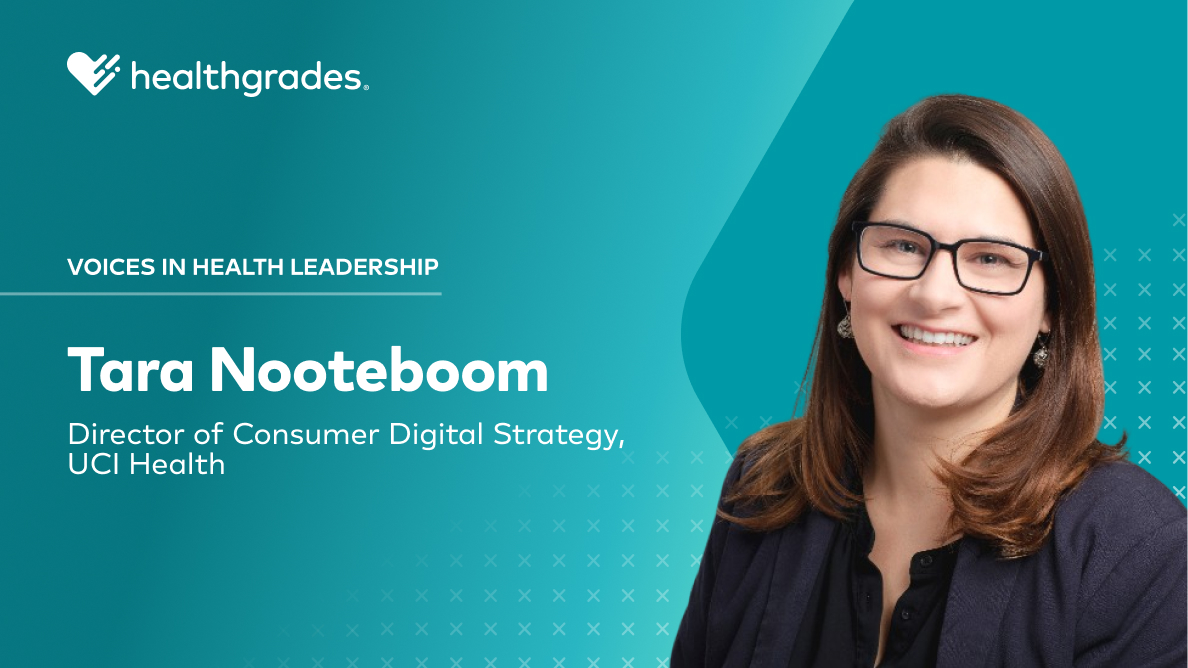
Voices in Health Leadership is a series spotlighting healthcare leaders reimagining access, experience, and innovation in a rapidly evolving landscape. Through candid conversations, we explore the real-world stories, strategies, and leadership insights shaping the future of care delivery.
Healthgrades’ Audrey Keller sits down with Tara Nooteboom, Director of Consumer Digital Strategy at UCI Health, to explore how digital strategy, trust, and cross-functional teamwork are driving better patient experiences and supporting rapid organizational growth.
I’m really excited to chat with you! To help set the stage, could you give me a brief overview of your role at UCI Health?
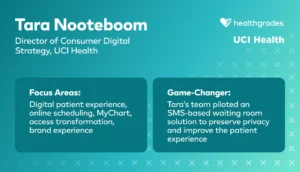
I’m Tara Nooteboom, and I’m the Director of Consumer Digital Strategy at UCI Health. Here at UCI Health, my team and I oversee a mix of core digital marketing functions—like our website, organic social media, and search listing management—and help lead our digital patient experience strategy. That includes working closely with our MyChart team on how we approach and execute authenticated experiences tied to our electronic medical record.
Beyond that, we support our ambulatory operations team on access transformation. We focus on how appointment templates are structured to improve availability for patients, as well as the different ways scheduling can happen—whether online, by phone, or through other channels. I also contribute to brand experience work, helping think through how our identity shows up operationally through digital tools.
What initially drew you to this industry, and what continues to drive your passion for this work?
My journey has taken a few twists and turns as I worked on digital experiences across different industries. I ended up in healthcare thanks to a fortuitous opportunity—and I completely fell in love with this industry. There’s so much potential to improve the user experience, and I love that about my job. How do you help someone navigate a complex system and find exactly what they need, especially when they might not be fully informed about their options?
Every small improvement we make can help ease the expaerience for patients navigating a very challenging environment. So that’s one reason I love what I do. The other is the people. So many people in this industry are here because they genuinely want to help others feel better and make a complex system more accessible. I love being part of organizations filled with that kind of purpose and energy.
Given how quickly digital transformation is accelerating, how should healthcare organizations define and measure meaningful patient engagement?
One of the most meaningful ways healthcare organizations should think about engagement is through the lens of completion. What does it look like for a patient to move from the initial phase of search or inquiry, to finding the right service, successfully scheduling an appointment, and ultimately completing that appointment? There are so many potential roadblocks on that journey—whether it’s prior authorization, difficulty finding the right service, not understanding the terminology, booking with the wrong specialist, not being able to find an appointment time, or running into insurance challenges. So, if we want to measure engagement in a way that truly reflects patient experience, we need to look at whether they were able to complete the journey.
I also think we need to pay close attention to the moments between appointments. Are we seeing a patient once and then nothing for six months until they return for a follow-up? Or are they engaging in multiple ways—sending a MyChart message, doing a virtual visit, or scheduling appointments in other service lines? That kind of ongoing connection is another important layer of engagement.
One thing I really aspire to do in my role is to listen more closely to the detailed feedback we get from patients. Even if an organization doesn’t have full journey-tracking capabilities, almost all of us collect post-visit experience surveys. Patients often leave thoughtful, detailed comments, and we share those results internally. A lot of systems use that data to coach clinicians or give feedback to staff.
But many of those comments are actually about digital experiences—how easy it was to make the appointment, how smoothly they connected with a clinician—and I don’t always think we, in digital, do a great job of taking that feedback to heart. It’s easy to fall into the trap of thinking we know best when it comes to delivering digital experiences. So, one thing I’m focused on with my team is making sure we’re integrating that feedback into how we measure—and improve—engagement.
I don’t always think we, in digital, do a great job of taking that feedback to heart. It’s easy to fall into the trap of thinking we know best when it comes to delivering digital experiences. So, one thing I’m focused on with my team is making sure we’re integrating that feedback into how we measure—and improve—engagement.
Tara Nooteboom, Director of Consumer Digital Strategy, UCI Health
There are larger systemic issues in healthcare, so many of the roadblocks you just mentioned are outside of your direct control. How do you think about your role in supporting your health system to create better patient experiences—even when you can’t make those changes yourself?
As digital strategy leaders, our relationships are critical to our success in impacting the patient experience. For example, some of my most important relationships are with our ambulatory operations partners. We’re in regular, day-to-day conversations about how the organization is functioning. How are we setting up physician schedules? What is our priority when it comes to getting patients in? How many new patients are we committing to seeing in a week? I also work very closely with our IT partners to understand the experience from a tactical standpoint—what features are we prioritizing, and what’s the impact on patients?
Take the website, for example. It sits at the intersection of marketing and digital experience, with ongoing support from IT. But without operational support—like access to appointment inventory—I can’t help patients book online. Digital scheduling isn’t just a feature we can turn on. It takes thoughtful, cross-functional coordination to make it work. That’s why cross-functional relationships across teams are absolutely essential. It’s the only way to be successful in digital.
As a follow-up—could you walk me through a specific example of a successful initiative at UCI Health? I’d love to hone in on one story that shows your work’s impact.
About a year and a half ago, as we were prioritizing patient experience, we started noticing a recurring piece of feedback. Patients really disliked having their names called out in the waiting room—especially when they were receiving sensitive types of care, like a colonoscopy, certain tests, or visiting a specialty doctor for the first time. This came through in patient comments and reviews, and we realized it was something we needed to address.
As an organization, we decided to focus on creating a more confidential callback process to improve the waiting room experience. At one of our newer locations, we were able to implement an SMS callback system. When a patient checks in—either at the front desk or via online eCheck-in—they provide a visit phone number. That could be their own number, or if they’re accompanied by someone, like a parent or caregiver, it could be that person’s number.
When it’s time for their appointment, the patient receives a text message—something like, “Hi Tara, it’s time for your appointment. Please meet me at Door 3.” Then, a team member is waiting at that door to greet and guide them back. This allows patients to grab a coffee, take a walk, or wait somewhere more private—without needing to sit in the waiting room or hear their names called out loud.
It’s a small change, but it’s a great example of a digital intervention that improves the patient experience. Of course, we needed our operations team on board to make it work at the front desk, and we needed IT to help with the technical infrastructure and messaging setup. But ultimately, this was a digital experience initiative that we were really excited to launch—one that really reflects what’s possible when we have cross-functional collaboration and when we’re sensitive to the feedback we get from patients about their experiences.
That’s such a great example of an innovative solution. As you look ahead, what are some of the major gaps in the digital patient experience that you’re hoping to tackle next?
We’re always thinking about how to improve access to our digital inventory—especially expanding online scheduling opportunities and supporting self-scheduling when it’s appropriate for the patient.
As an academic medical center, we have many subspecialists—tertiary and quaternary care teams—who treat very specific conditions. One of the big challenges we’re always working on is how to build a data infrastructure that not only maps expertise to the right conditions but also makes it possible to guide patients to the appropriate physician, even when the path is complicated.
Right now, we’re using decision trees—an Epic EMR functionality—to help with this. But we’re constantly exploring ways to better support that digital-first experience: helping patients get in the door quickly and efficiently and ensuring they’re matched with the right doctor in a timely fashion.
That kind of work requires a holistic approach. It’s something I don’t think we’ll ever be “done” with—there’s always room to evolve. But the more we can enable self-scheduling for straightforward needs, the more we can free up staff and resources to support patients who do need more of a guided, relationship-based approach—like someone new to the system or navigating a complex condition. But we can’t do that effectively if our teams are tied up handling basic scheduling tasks for every patient.
Let’s shift gears a bit and talk about the broader landscape. What key trends do you see reshaping patient expectations and influencing the way health systems deliver care?
I think one interesting aspect of how we identify trends in healthcare—especially from within a health system—is that our focus tends to split across a few different areas.
A lot of health systems tend to look laterally: What is my neighbor doing? What kind of experiences is the hospital next door offering? Or, we benchmark against top-performing hospitals across the country. It becomes a bit of a “keeping up with the Joneses” mindset when it comes to patient experience.
At the same time, we often get caught up in our own operational inefficiencies or the needs of our clinical teams. And those are very real drivers. Clinicians are a limited and incredibly valuable resource, and they’re under constant pressure—to see more patients, to see them more quickly, and to deliver more compassionate, personalized care. They’re being pulled in many directions, and that reality plays a big role in how we design and prioritize experiences.
Of course, we also rely heavily on patient feedback—whether that’s through surveys or behavioral data—to guide us. But I think there’s another important layer that we sometimes overlook: the expectations patients bring with them from outside the healthcare system.
Other industries have set standards around what a good transactional experience looks like—how relationships should be built, what it means to feel “known” as a customer. And patients bring those expectations with them. They want to feel recognized, but not in a way that’s intrusive or makes them uncomfortable. It’s a delicate balance: “I want you to know me, but I don’t want you to know me so much that I feel uncomfortable.”
Healthcare isn’t the only industry navigating that balance, but we’ve been slower to adapt. That’s partly because we haven’t always had the margins or incentives to invest in those types of experiences the way other industries have.
One clear example of where healthcare still has a lot of room to grow is CRM—Customer Relationship Management. In most industries, CRM is both a tool and a strategy that helps organizations understand the full 360-degree view of a customer, including prospective customers. It’s about seeing the full picture. But in healthcare, we often think in silos: How was your primary care visit? What happened at your GI appointment? What’s your treatment plan for this condition? And we build engagement strategies around those isolated touchpoints.
We’re starting to realize that we also need to consider the broader view: What does your full journey with us look like? That includes your clinical visits, your digital interactions, your phone calls, your billing experience—everything. We’re starting to move in that direction, but as an industry, we’re still in the early stages of embracing that truly integrated, end-to-end view of the patient experience.
I want to pause here and give you a moment to reflect on UCI Health—its values, its culture, and anything else you think helps paint a meaningful picture of the organization.
I’ve been at UCI Health for about three years now—I started in the spring of 2022, coming here alongside our UCI Health Chief Strategy Officer, Tatyana Popkova, from a prior organization. I’ve been really impressed with this organization, particularly its growth mindset. I think we’re in a really special era for UCI Health in terms of how we’re embracing transformation and looking ahead to the future.
In many health systems—understandably, given our responsibility for people’s health and well-being—there’s a tendency to be risk-averse. That caution is important for maintaining safety and quality, but it can also slow innovation. The default response to new ideas is often “no,” and you work from there to earn a “yes.”
What I’ve experienced at UCI Health is the opposite. This is a yes organization. The question here isn’t if we’ll move forward, it’s how. Yes—how do we do this safely? Yes—how do we maintain the level of care our patients expect? Yes—how do we move forward even with fewer or more limited resources than we’ve had before? That mindset is incredibly energizing, especially for someone focused on the consumer experience. It’s such a dynamic, evolving area in healthcare, and to be part of a system that’s open to change and driven by possibility is a gift.
A great example of that culture is our recent acquisition. For the first time since the late 1970s, UCI Health is now a multi-hospital system. We went from one hospital to five overnight—and that’s in addition to rapid growth in our ambulatory network, both inside and outside of that acquisition.
UCI Health is… a yes organization. The question here isn’t if we’ll move forward, it’s how. Yes—how do we do this safely? Yes—how do we maintain the level of care our patients expect? Yes—how do we move forward even with fewer or more limited resources than we’ve had before? That mindset is incredibly energizing, especially for someone focused on the consumer experience.
Tara Nooteboom, Director of Consumer, Digital Strategy
And we’re not stopping there. We have a new hospital opening later this year—a ground-up build, not an acquisition—and a joint venture rehabilitation hospital planned, as well. Within just three years, we’ll have gone from a single hospital to seven.
That kind of growth says a lot about who we are as an organization. It reflects a deep commitment to evolving, expanding access, and delivering exceptional care to more people in more ways. It’s a really exciting time to be at UCI Health—and even as the industry continues to shift, we’re staying focused on what’s next.
I want to make a bit of a leap here. Given your expertise, I’d love to hear what you think about UCI Health’s digital presence as a tool for patient acquisition. How do you balance that with the many different ways consumers are navigating their healthcare decisions today?
I think there’s an interesting intersection there. Especially in a growth organization like ours—where we’re acquiring new locations, expanding our network, and entering into joint ventures or strategic affiliations—I actually think of my role as just as much about retention as it is about acquisition.
My job is to make sure that when someone hits one of our digital properties—whether it’s a search result on Google, a page on our website, or a landing page from an ad—and they pick up the phone or take the next step, it feels seamless and trustworthy. I see that interaction as the beginning of a relationship. Is it sticky? Is it clear? Is it helpful?
Whether we’re designing a website or optimizing a search listing, our job is always to build trust and make things easy. I want people to feel confident, comfortable, empowered—and able to complete whatever task brought them there. That’s retention, even when the person is still in the “consumer” phase, shopping around. But at the same time, when that first experience is smooth and trustworthy, that’s also an acquisition strategy—it just shows up through a different lens.
Once someone becomes a patient, we’re still reacquiring them all the time. Just because someone comes to us for a highly specialized service doesn’t mean they’ll automatically think of us for primary care. Someone who sees us for primary care might not think of us for urgent care. So from my team’s perspective, acquisition includes building digital experiences that not only convert new patients but also cross-sell and reinforce the value of our broader network. That’s how we keep people engaged—not just for one episode of care, but throughout their journey.
Before we wrap up, is there anything we didn’t touch on that you’d like to add?
I’d just highlight something I touched on earlier—something most teams know but don’t always practice: the importance of cross-functional relationships, especially with operations. Most people in marketing or digital strategy roles are used to working closely with IT, but building strong partnerships with operations is just as critical.
At UCI Health, we’re in a unique position because our ambulatory network actually sits within our strategy function, the same as digital. That formal connection is really helpful. But even outside of organizational structure, I’d say that relationship is the number one driver of meaningful digital experience work. Without it, we can only impact certain slices of the patient journey. With it, we can step back and address the entire journey, end to end.
That kind of partnership is, in my view, the most important pathway to success when it comes to delivering digital experiences that truly make a difference.
About UCI Health
UCI Health is Orange County’s only academic health system, delivering world-class care through leading-edge clinical services, innovative research, and the education of future healthcare leaders. Headquartered in Orange, California, UCI Health offers a full spectrum of care—from cancer, cardiology, and neurology to women’s health and emergency services.
With a culture rooted in excellence, compassion, and innovation, UCI Health embraces transformation while maintaining trust and safety at its core. Following the 2024 acquisition of Tenet’s Pacific Coast Network, UCI Health has grown from a single-hospital system to a dynamic network of five hospitals—with two more on the way—underscoring its commitment to expanding access and delivering exceptional care across Southern California.
Looking to improve digital access and patient engagement at your health system? Get in touch with us today to learn how Healthgrades can help you connect with the right patients at the right time—the moment they’re ready to book an appointment.