
Jul 17, 2025
|Blog
Building Smarter, Stronger Patient Connections in a Digital Era with Tampa General Hospital
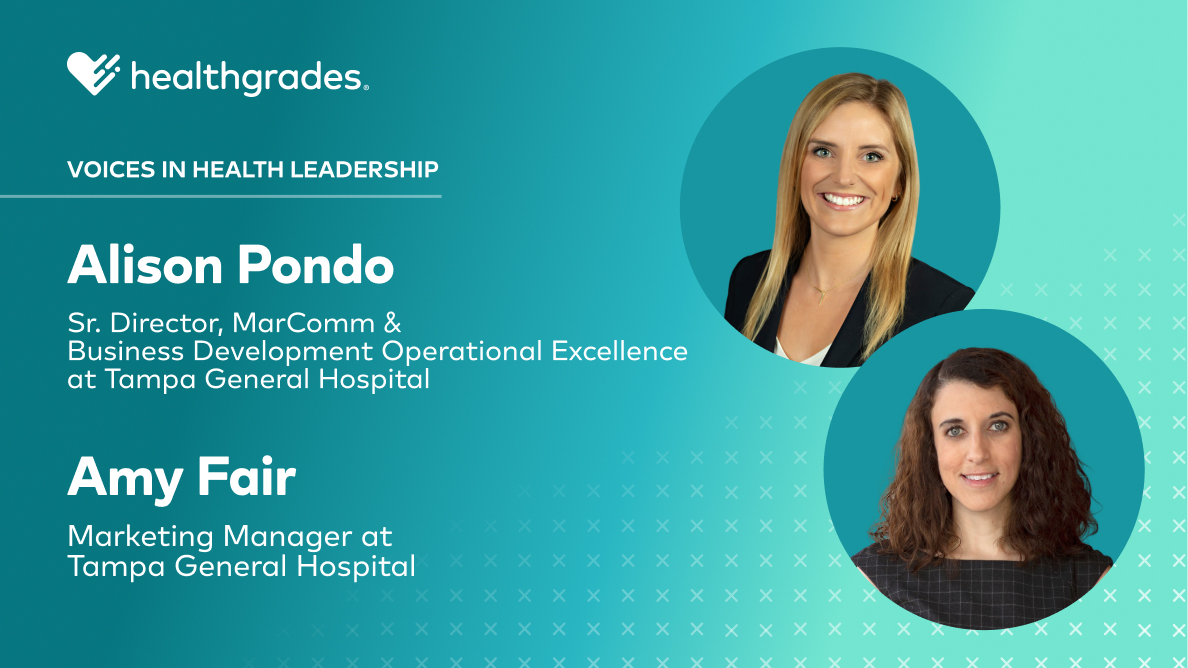
Voices in Health Leadership is a series spotlighting healthcare leaders reimagining access, experience, and innovation in a rapidly evolving landscape. Through candid conversations, we explore the real-world stories, strategies, and leadership insights shaping the future of care delivery.
Healthgrades’ Audrey Keller sits down with Alison Pondo and Amy Fair of Tampa General Hospital to explore how digital strategy, service line marketing, and community partnerships are creating more connected, patient-centered care. From virtual health and AI to brand trust and data-driven engagement, TGH shares how they’re building stronger relationships—and measurable impact—across the system.
To help set the stage, could you introduce yourself, share what initially drew you to the healthcare industry, and tell us what continues to drive your passion for the work?
Alison Pondo: My name is Alison Pondo, and I’m the Senior Director of MarComm and Business Development Operational Excellence at Tampa General Hospital.
Amy Fair: I’m Amy Fair, Marketing Manager at Tampa General Hospital.
Alison Pondo: Growing up, my mom was a nurse, so I was always interested in healthcare. She introduced me to it early on, and at the same time, I was also really interested in communications. In college, while pursuing my undergraduate public relations degree, I started thinking about which industries I could apply my knowledge and skill set to.
The more I explored healthcare, the more it intrigued me, especially with my mom’s background in the field. That led me to pursue a master’s in public health, and during my final semester, I had the opportunity to intern with Tampa General Hospital in their marketing department.
After that internship—and after I graduated—I was hired full-time as a marketing coordinator. Now, here I am, almost 10 years later. What’s kept me here is that I’m constantly learning. I consider myself a lifelong learner, and in healthcare, there’s always something new to explore or understand.
But it’s also the passion of the people who work in this space. The opportunity to make a real impact and be part of life-changing work drives so many people in healthcare, both clinical and non-clinical. At Tampa General, I always say: There are truly miracles happening here every single day. And in our roles, we have the privilege of sharing that with the community and beyond.
Amy Fair: I couldn’t agree more. What’s happening at Tampa General is incredible. But I actually came into healthcare through a very different path. I started in another industry and eventually came across this role at Tampa General. I remember thinking, “That could be interesting—let’s see what it’s about.”
I’m actually a pediatric cancer survivor, and I’ve always had a deep connection to healthcare. I even started pre-med in undergrad—but that didn’t last very long! So, when I saw this role, I thought it was the perfect opportunity to combine my two passions: my love for marketing and my appreciation for the healthcare professionals who helped me along the way. It’s been amazing to be part of Tampa General and to see what goes on in this organization firsthand.
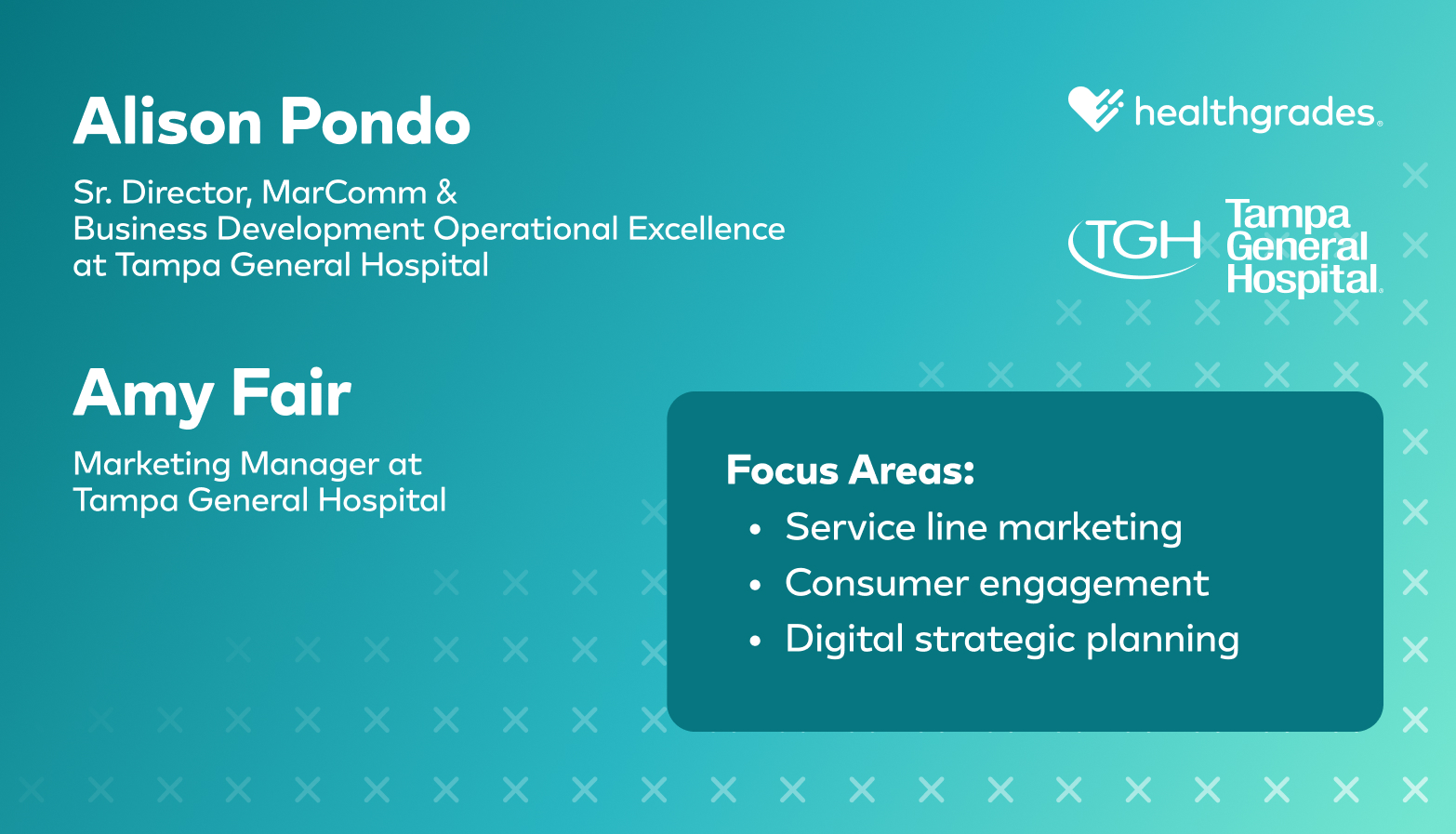
As you know, the healthcare landscape is evolving rapidly. What key trends are reshaping patient expectations and how health systems deliver care?
Alison Pondo: Two areas stand out to me—and these trends aren’t just influencing healthcare, but nearly every industry. First is artificial intelligence. AI is already enhancing so many corners of healthcare—improving diagnostics, predictive analytics, and even enabling more personalized treatment plans.
Within our marketing team, we’re actively identifying and implementing AI tools to improve our workflows and find efficiencies that help us be more productive. We’ve got brilliant people doing really smart things, but we’re also looking at how AI can help us deliver more personalized messaging and experiences to our consumers.
As consumers begin interacting with AI across all kinds of industries, they’ll expect that same level of personalization and efficiency in healthcare, too. That leads to the second trend: evolving, consumer-driven expectations.
Our patients are also consumers in every other part of their lives—whether they’re using Amazon, Apple, or Uber—and they’ve come to expect a similar level of ease and responsiveness. So we’re constantly asking ourselves: How can we deliver patient-centered care that meets those expectations?
That includes everything from easily scheduling an appointment and checking in early to getting real-time updates or receiving care through virtual platforms. It’s all about making the experience more convenient and aligned with what people are used to elsewhere.
Amy Fair: With the world becoming more virtual over the past five years, healthcare has had to evolve to meet people where they are. At Tampa General, we now offer a wide range of virtual options, enabling patients to connect with their care teams, attend appointments, and manage follow-ups in ways that are more convenient, flexible, and accessible.
By offering a wide range of virtual options, we enable patients to connect with their care teams, attend appointments, and manage follow-ups in ways that are more convenient, flexible, and accessible.
Amy Fair, Marketing Manager, Tampa General Hospital
AI is also top of mind for us, but getting new technologies approved in healthcare can be complex, with multiple teams involved and serious security considerations. How are you balancing the need to stay ahead of evolving expectations with the challenges of implementing tools like these?
Alison Pondo: That’s a great question—and one Tampa General has been really intentional about. Our teams have built an AI Governance Council that brings together voices from across the organization—clinical, ethics, compliance, security, and the teams who will actually use the tools. That cross-functional approach helps us evaluate each AI solution not just for functionality, but also for safety, ethical integrity, and alignment with our mission.
The council has reviewed around 30 offerings so far, making sure every tool we consider meets our standards for patient data protection and regulatory compliance. It’s a thoughtful, collaborative process that helps us move forward with confidence.
Let’s now shift into measurement. How is Tampa General defining and measuring meaningful patient engagement, particularly as you continue to evolve your digital strategy and implement new technologies?
Alison Pondo: That’s something we’re consistently focused on—how we’re measuring real connections with patients. It’s not just about getting messages out into the world. Take social media, for example. Our most important KPI isn’t reach or impressions. It’s engagement. We’re always asking what KPIs actually reflect impact. How are people interacting with what we’re putting out there?
As digital tools continue to evolve, we’re increasingly able to meet patients where they are—with personalized, timely, and relevant content. It’s not just about pushing information out anymore. Instead, it’s about creating two-way communication. We’re thinking about how to provide interactive digital tools that drive not just engagement but action and outcomes.
At every level, we’re also looking at patient feedback, whether that’s through surveys, online reviews, or Net Promoter Score. We want to understand satisfaction, loyalty, and long-term connection.
As digital tools continue to evolve, we’re increasingly able to meet patients where they are—with personalized, timely, and relevant content. It’s not just about pushing information out anymore. Instead, it’s about creating two-way communication. We’re thinking about how to provide interactive digital tools that drive not just engagement but action and outcomes.
Alison Pondo, Sr. Director, MarComm & Business Development Operational Excellence at Tampa General Hospital
Amy Fair: To build on that, MyChart has been such an important tool on our side. It gives patients direct communication with their physicians—one-on-one access when they have a question or concern.
Alison, from your perspective, is there a specific initiative at Tampa General that stands out as a success story?
Alison Pondo: Tampa General has recently implemented several strategies to improve digital engagement and create a more seamless experience for our patients.
As an organization, we’ve leaned more heavily into virtual health and expanded our telehealth offerings across multiple specialties, including behavioral health. We’ve also incorporated telehealth into areas of specialty care. As an academic health system, we offer truly world-class care, and we’ve been focused on finding meaningful ways to extend that level of care through telehealth, creating more convenient connections between patients and their physicians when appropriate. This gives patients greater flexibility while enabling personalized, one-on-one interactions when needed.
Another area we’ve recently enhanced is our physician finder and online scheduling tool on our website. We launched a much-improved experience that includes smart filtering by specialty, location, and availability. It also features integrated scheduling for both in-person and virtual appointments, giving patients greater control and convenience.
As Amy mentioned, MyChart is a key part of our digital strategy. It allows patients to manage their health information, appointments, prescriptions, and communication with their care team in one place.
One successful initiative I want to highlight is our work with Healthgrades and the Physician Direct Connect (PDC) program. We know patients are more empowered than ever when researching care options. They read reviews, compare physicians, and make informed decisions—essentially, it’s digital word-of-mouth.
We’ve recognized the important role Healthgrades plays in the patient decision-making process—particularly given the high-intent traffic on healthgrades.com. Since launching our partnership over three years ago, we’ve collaborated closely with internal teams across business intelligence, IT, and finance—as well as with our partners at Healthgrades—to track the downstream impact of patients who begin their journey on the platform. That includes monitoring actual encounters within our system and evaluating overall return on investment.
One successful initiative I want to highlight is our work with Healthgrades and the Physician Direct Connect (PDC) program. We know patients are more empowered than ever when researching care options. They read reviews, compare physicians, and make informed decisions—essentially, it’s digital word-of-mouth.
Alison Pondo, Sr. Director, MarComm & Business Development Operational Excellence at Tampa General Hospital
We love hearing that kind of feedback! It’s always exciting to hear when our programs work well and play a role in your broader strategy. Switching gears a bit—Amy, what are you most proud of on your team right now?
Amy Fair: One of the things I wanted to highlight is how our marketing team is structured—we’re divided into service lines. I personally manage marketing for about five different service lines along with other programs and services, and that gives me the opportunity to get to know each area really well, understand their goals, and build strong relationships with the teams.
We meet regularly, and through those conversations, I get to better understand who the patient is for each service—someone who might need spine surgery, for example. We use a combination of internal dashboards and external market research to build a deeper understanding of that audience. From there, we put together a consumer playbook for each institute. Using the Neuroscience Institute as one example, we create a profile of who that patient is and identify the most effective ways to reach them.
Depending on the goal, we use a mix of paid, owned, and earned media. We partner closely with our PR and Physician Business Development teams as well to ensure we’re meeting those goals and effectively supporting each service line.
Let’s move on to brand loyalty and patient trust. Amy, how does your team think about building and maintaining trust with patients?
Amy Fair: Absolutely. One of the key things we focus on is showing who our patients are and what their journeys look like. One way we do this is through patient video testimonials. We’ll identify a patient who came to TGH at a challenging time and received life-changing care—often a surgery or treatment that really transformed their quality of life. If they’re open to sharing their story, we work with them to create a video that highlights their experience.
It’s an incredibly powerful way to build trust with other patients who may be exploring their options. It shows what’s possible when they come to a place like Tampa General and puts real faces and real outcomes behind the care we provide.
We also prominently highlight our awards and recognitions. Market research has shown that those distinctions really matter to patients. People want to feel confident that they’re coming to a trusted place, not just by their community and peers, but also by other healthcare professionals. Those recognitions help reinforce that sense of credibility and quality.
Beyond trust, how do you think about helping patients feel empowered to take charge of their health and make informed care decisions?
Alison Pondo: That aligns really well with a lot of what we’ve talked about today. It starts with meeting patients where they are and making it easy to take that first step, whether scheduling an appointment or exploring care options.
We also have some incredible community partnerships. One I’d love to highlight is an initiative called TampaWell. It’s a collaboration with organizations throughout the community, and one of its key goals is to promote food as medicine. We work with patients and their physicians to help them understand the role of nutrition in healing and how food can be a critical part of the health journey.
As part of TampaWell, we also support a community garden to help address food insecurity in areas considered food deserts. Beyond that, we’re continually promoting healthy, active lifestyles by partnering with organizations that encourage physical activity, wellness, and preventive care. It’s truly a community-driven effort to help people take action for their health in approachable and sustainable ways.
How do you think the role of health systems is evolving when it comes to supporting more informed decision-making?
Amy Fair: It’s hugely important, especially for us as an academic health system. We partner closely with the University of South Florida. Through that collaboration, we’re working on less invasive, more accessible techniques that appeal to people who might be living with chronic pain or other barriers to care. Sometimes the first step is just helping someone feel confident enough to schedule a consultation. From there, they can see if they’re a candidate for something minimally invasive—something that feels less intimidating. That initial outreach and education can go a long way toward building trust and encouraging people to take that next step in their care journey.
Alison Pondo: That ties back to our shared purpose: We heal. We teach. We innovate. Care for everyone, every day. It truly is a pillar of who we are.
About Tampa General Hospital
Tampa General Hospital (TGH) is one of Florida’s largest academic health systems and the region’s only safety net hospital. With eight medical specialties ranking in the top 50 programs in the United States, TGH serves as the primary teaching hospital for the USF Health Morsani College of Medicine. TGH has 981 licensed beds and approximately 15,000 team members and physicians and is home to the region’s only Level I Trauma Center, one of Florida’s two ABA-verified burn centers, and the top organ transplant center in the country—providing exceptional care across a full spectrum of services, from complex procedures to everyday wellness.
Looking to improve digital access and patient engagement at your health system? Get in touch with us today to learn how Healthgrades can help you connect with the right patients at the right time—the moment they’re ready to book an appointment.